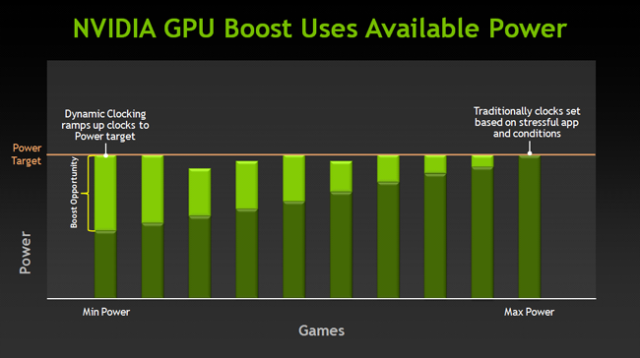
Nvidia's GPU Boost 2.0 is one of the few new things the GeForce 700M chips offer over their predecessors.
The answer is "not a whole lot," though there are some tidbits here and there. AnandTech has done a characteristically thorough job of wrangling the specifications of the chips, showing a group of chips with marginally higher clock speeds than their predecessors—the GeForce GT 745M, for example, has a GPU clock speed of "up to" 837MHz and memory clock speed of "up to" 5GHz, compared to 710MHz and 4GHz for the GeForce GT 645M. These increases should be good for gains of about "15-25 percent relative to the previous models," provided that PC makers don't lower these clock speeds too much to save power. This is a respectable boost over current chips given that the architecture and manufacturing processes are both the same, but not enough to warrant upgrading that laptop you bought a couple of months ago.
The specific GPUs being announced are all aimed at mainstream laptops rather than high-end gaming laptops; the GeForce GT 750M, 745M, and 740M GPUs cover the middle end of the market, while the GeForce GT 735M and 720M are aimed at lower-end laptops that want something slightly better performing than Intel's integrated graphics. High-end gaming laptops will continue to be served by "last-generation" products like the GeForce GTX 675MX and 680MX, though since these chips are still based on the Kepler architecture, new buyers won't be missing out on much.
DIGITAL JUICE


No comments:
Post a Comment
Thank's!