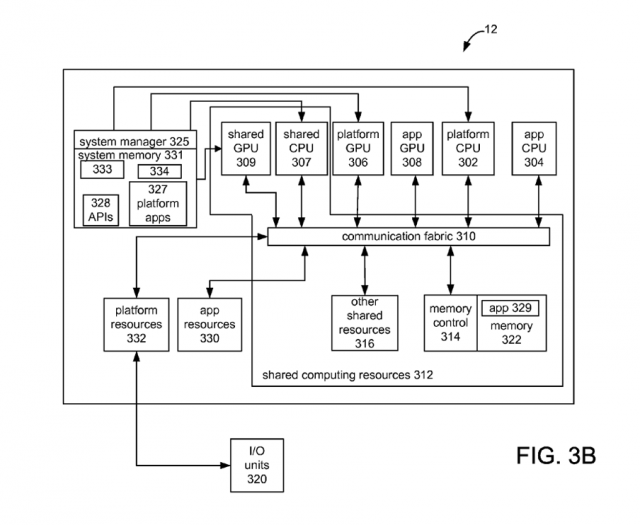
One of many possible processor-sharing configurations discussed in a Microsoft patent for a more flexible game system architecture
For better or worse, one thing you can generally count on in the console gaming market is that a system you buy on launch day will have the same basic capabilities as the same system bought six years down the line. Even though numerous internal hardware revisions in that time might reduce the component size and lower the production costs, anything designed to work on one configuration of the console would have to work on all the earlier ones as well. But a patent application filed by Microsoft suggests that the company may be looking to release its next Xbox in multiple configurations, each with varying hardware power and capabilities. A patent like this usually wouldn't be so interesting on its own; Microsoft files patents all the time, and most never see the light of day. But this one includes details that are intriguingly similar to those included in the now famous "Xbox 720" leak that came to light last month.
Microsoft's patent for a "Scalable Multimedia Computer System Architecture With QOS [Quality Of Service] Guarantees" describes a design for a game system that is capable of "allowing platform services to scale over time." Those "platform services" include pretty much everything the hardware does besides directly running games—everything from maintaining the basic operating system, handling network traffic, and interpreting inputs to potentially streaming content to nearby tablets or recording TV shows.
A standard console configuration might explicitly devote one entire CPU/GPU combo to handling those basic platform functions, while other processors are dedicated to the game-playing "application" functions. But Microsoft's patent describes a new "communication fabric" framework that would let the system allocate computing resources more flexibly between platform and application tasks concurrently, while also ensuring that the game-playing portion doesn't dip below a certain quality threshold. So the operating system would be able to use as much processing power as it wants, as long as it doesn't interfere with the performance of a game that's running at the same time.
Read 5 remaining paragraphs | Comments
DIGITAL JUICE


No comments:
Post a Comment
Thank's!