Lawmakers in the House moved yesterday to block the FCC from spending any money granting LightSquared’s conditional spectrum permit until the company is able to prove its network won’t cause widespread blackouts in GPS service.
The House Appropriations Committee adopted an amendment to its 2012 appropriations bill that would stop FCC funding “to remove conditions on or permit certain commercial broadband operations until the FCC has resolved concerns of harmful interference by these operations on Global Positioning System (GPS) devices.”
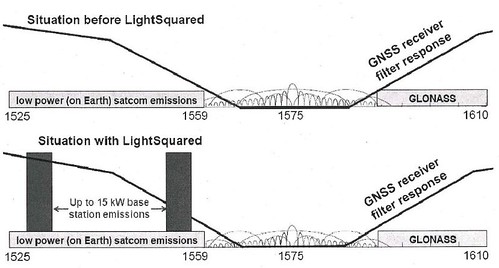
A Thursday House hearing on the impact of LightSquared’s network on GPS systems heard from witnesses from government agencies including the Defense Department and Coast Guard, as well as stakeholders in the GPS industry, testified that testing showed LightSquared’s network could have a devastating effect on GPS systems if allowed to go live in spectrum bordering airwaves used by GPS.
Jeff Carlisle, Executive VP for Regulatory Affairs and Public Policy for LightSquared, defended his company’s position (pdf) at yesterday’s hearing.
The witnesses also testified that further testing was needed to ensure that LightSquared’s revised launch plans would resolve the issue. LightSquared says its network will not have any impact on 99.5 percent of GPS receivers under its reworked plan, which would only use the lower 10 MHz of Inmarsat’s spectrum for its on-the-ground LTE services.
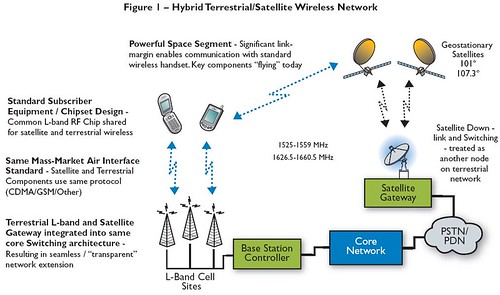
The Lightsquared proposal has received a lot of flack from the GPS community. A coalition against the Lightquared proposal (pdf) was stongly against the LightSquared network of 40,000 base stations because it interfered with the GPS technology, especially with high precision agriculture equipment and services.
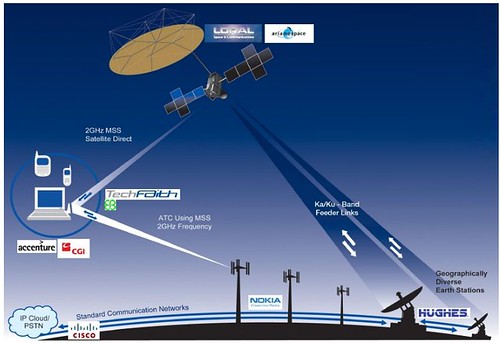
As an aside, I previously believed that the FCC had authorized the two other 2 GHz Mobile Satellite Service (MSS) providers, TerreStar and ICO (both now bankrupt), to also offer terrestrial (ATC) service. Apparently that is not the case. DBSD (ICO) and TerreStar have not been granted a waiver, according to Tim Farrar. Only Lightsquared, on the 1.6 GHz band, has been tentatively granted FCC approval for terrestrial repeaters — if the company can prove that it does not interfere with GPS services.
While Lightsquared claims to have spent nearly $1 billion on its huge spot-beam platforms, the satellites themselves were something of a Trojan Horse, in order to get access to a nationwide footprint of terrestrial 1.6 GHz spectrum for LTE, without paying $3-5 billion for the spectrum in an auction.

Both ICO and Terrestar launched operational satellite platforms over the United States – but the business never got off the ground. Both declared bankruptcy even before offering commercial services. As a standalone satphone company (without terrestrial 1.6 GHz spectrum), it’s hard to understand how Lightsquared would be any different.
Sure, Sprint might offer local terrestrial 2.6 GHz LTE access or even 700 MHz first responder access for the satellite provider using dual-mode phones. But those access methods wouldn’t make any money for Lightsquared – it would just add more costs to their bottom line.
Related DailyWireless Space and Satellite News includes; Lightsquared: Plan “B”, Lightsquared + Sprint Deal Done?, Lightsquared Gets 2-week Extension, Charlie Ergen’s Spectacular Triple Play, Lightsquared Interference: No Immediate Fix?, LightSquared: GPS Interference Found, Lightsquared: Plan B from Outer Space?, Harbinger: 59MHz or What?. Time Warner Cable + Lightstream?, Lightsquared Signs Cricket Wireless, Another Rumor: Lightsquared + Sprint?, Lightsquared + Sprint?, Charlie’s Big Play, LTE Spectrum: It’s War, Lightsquared: What GPS Interference?, Harbinger Sells Inmarsat Shares, FCC Green Lights Lightsquared, LightSquared: In Trouble?, Lightsquared Unfurled, MetroPCS Eyes TerreStar and Charlie Ergen’s Spectacular Triple Play
"

No comments:
Post a Comment
Thank's!