Sunday, July 1, 2012

The Snarky Voice in Your Head Is Killing Your Productivity; Here’s How to Stop It [Snark]

The Snarky Voice in Your Head Is Killing Your Productivity; Here’s How to Stop It [Snark]:
There's a jerk inside all of us: we roll our eyes when someone in line has a complicated order, curse at little old ladies who don't drive fast enough, and sneer at people who are just too happy. Over time, that snark kills our productivity and poisons our relationships. Here's how to keep your inner asshole in check. More »


DIGITAL JUICE

If You Only Do One Type of Weight Training, Do Squats [Exercise]

If You Only Do One Type of Weight Training, Do Squats [Exercise]:
Not everyone has a ton of time or interest for weight training. However, The New York Times suggests that the one exercise everyone should work into their daily routine is squats. More »


DIGITAL JUICE

Google Compute Engine: Computing without limits

Google Compute Engine: Computing without limits: Posted by Craig McLuckie, Product Manager, Google Compute Engine


(Cross-posted from the Google Developers Blog.)


Over the years, Google has built some of the most high performing, scalable and efficient data centers in the world by constantly refining our hardware and software. Since 2008, we've been working to open up our infrastructure to outside developers and businesses so they can take advantage of our cloud as they build applications and websites and store and analyze data. So far this includes products like Google App Engine, Google Cloud Storage, and Google BigQuery.


Today, in response to many requests from developers and businesses, we're going a step further. We're introducing Google Compute Engine, an Infrastructure-as-a-Service product that lets you run Linux Virtual Machines (VMs) on the same infrastructure that powers Google. This goes beyond just giving you greater flexibility and control; access to computing resources at this scale can fundamentally change the way you think about tackling a problem.


Google Compute Engine offers:
  • Scale. At Google we tackle huge computing tasks all the time, like indexing the web, or handling billions of search queries a day. Using Google's data centers, Google Compute Engine reduces the time to scale up for tasks that require large amounts of computing power. You can launch enormous compute clusters - tens of thousands of cores or more.
  • Performance. Many of you have learned to live with erratic performance in the cloud. We have built our systems to offer strong and consistent performance even at massive scale. For example, we have sophisticated network connections that ensure consistency. Even in a shared cloud you don’t see interruptions; you can tune your app and rely on it not degrading.
  • Value. Computing in the cloud is getting even more appealing from a cost perspective. The economy of scale and efficiency of our data centers allows Google Compute Engine to give you 50% more compute for your money than with other leading cloud providers. You can see pricing details here.


The capabilities of Google Compute Engine include:
  • Compute. Launch Linux VMs on-demand. 1, 2, 4 and 8 virtual core VMs are available with 3.75GB RAM per virtual core.
  • Storage. Store data on local disk, on our new persistent block device, or on our Internet-scale object store, Google Cloud Storage.
  • Network. Connect your VMs together using our high-performance network technology to form powerful compute clusters and manage connectivity to the Internet with configurable firewalls.
  • Tooling. Configure and control your VMs via a scriptable command line tool or web UI. Or you can create your own dynamic management system using our API.


At launch, we have worked with a number of partners - such as RightScale, Puppet Labs, OpsCode, Numerate, Cliqr and MapR - to integrate their products with Google Compute Engine. These partners offer management services that make it easy for you to move your applications to the cloud and between different cloud environments.


You can learn more about Google Compute Engine here. We’re going to pace ourselves and start with Google Compute Engine in limited preview (sign up here), but our goal is to give you all the pieces you need to build anything you want in the cloud. Whether you need a platform like Google App Engine, or virtual machines like Google Compute Engine, these days, you define your limits. We’re just at the start of what the cloud can do.


DIGITAL JUICE

Get things done anytime, anywhere: Announcing offline document editing and Google Drive for iOS

Get things done anytime, anywhere: Announcing offline document editing and Google Drive for iOS: Posted by Clay Bavor, Product Management Director


(Cross-posted on the Google Docs Blog.)


In April, we introduced Google Drive, a place where you can create, share, and keep all your stuff. Today at the Google I/O conference we announced two new ways to get things done in the cloud: offline editing for Google documents and a Drive app for iPhone, iPad, and iPod touch.


Offline document editing 


No internet connection? No big deal. With offline editing, you can create and edit Google documents and leave comments. Any changes you make will be automatically synced when you get back online.


You can enable offline editing from the gear icon in Google Drive and find more detailed instructions for getting set up in the Help Center. Note that you’ll need the latest versions of Chrome or ChromeOS to edit offline. We’re also working hard to make offline editing for spreadsheets and presentations available in the future.


Google Drive for iOS 


We launched the Drive app for Android phones and tablets a few weeks ago, and starting today, Google Drive is available for your iPhone, iPad and iPod touch.


With the Drive app, you can open PDFs, photos, videos, documents and anything else stored in your Drive while you're on the go. You can also search all your files, add collaborators to documents, and make files available offline to view them even without an internet connection. For blind and low-vision users, the app also works great in VoiceOver mode. Learn more about what you can do with the app in our Help Center.


Get Drive in the App Store for your iPhone, iPad or iPod touch running iOS 5.0+ and visit the Play Store to get the latest on your Android phone or tablet.


To learn more about Google Drive, visit drive.google.com/start.


DIGITAL JUICE

Saturday, June 30, 2012

If malware authors ever learn how to spell we're all screwed - the coming HTML5 malware apocalypse

If malware authors ever learn how to spell we're all screwed - the coming HTML5 malware apocalypse:
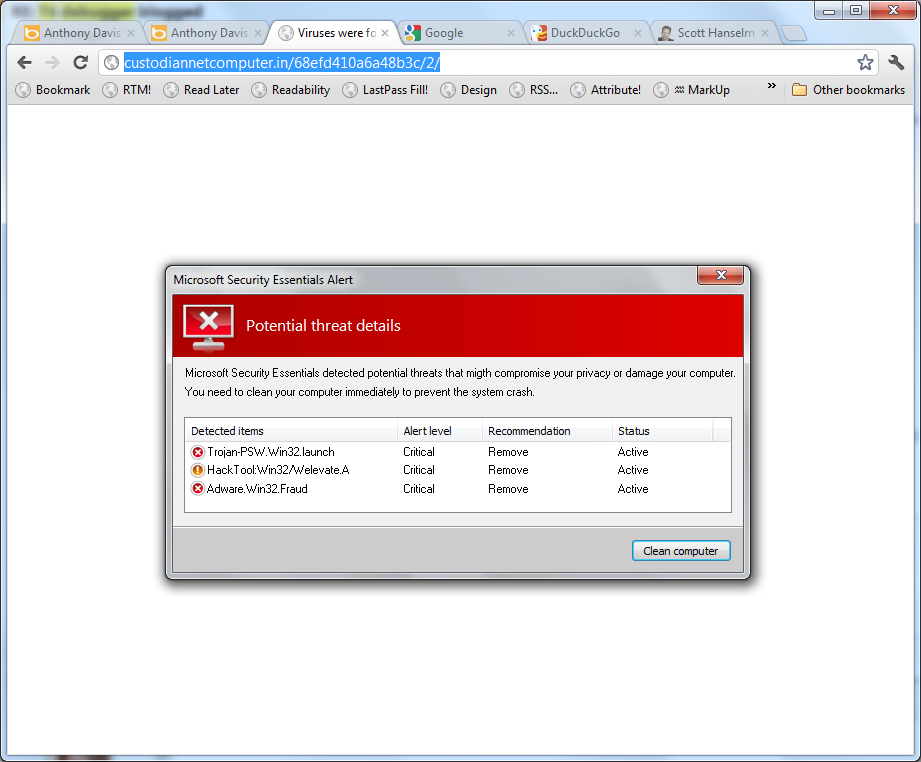
Forgive the lousy screenshot and transparency in the title bar, but I just got this fake virus popup while searching for an image. I admit for a single moment my heart jumped.
A very scary fake virus popup
Then I thought after a few seconds as a techie (and note that all these observations just happened all at once in my head in no order):
  • The dialog is perfectly centered in the browser. I'm not sure why this was my #1 tipoff, but for me, it was the first thing I noticed.
  • This "popup" was as a result of a browser navigation. If it were legit I'd expect it to happen a little more asynchronously.
  • The word "migth" misspelling in the popup.
  • The fonts in the column headers are anti-aliased with one technique and the rest of the text doesn't  use ClearType while my machine does.
  • Poorly phrased English: "You need to clean your computer immediately to prevent the system crash."
  • There's no option other than "Clean computer." No ignore, repair, quarantine.
  • The word "computer" at the end of the first line goes too far to the right of the grid's right margin. It should have wrapped to the next line. Yes, I'm a UI nerd.
  • Their Aero theme color is GRAY and mine is BLUE.
  • Ctrl-Scroll ZOOMs the image. ;)
  • The URL is obvious nonsense.
  • Adware.Win32.Fraud? Seriously?
It's scary just to look at floating in your webpage there isn't it?
A scary fake virus popup
How is my Mom supposed to defend against this? Windows OR Mac (or tablets) the bad guys are out there, and one day they will finally learn English and put a little work and attention to detail into these things.
One day these things won't be "selectable" to prove to us that they are HTML:
I selected the virus to make it invert its colors to prove it's fake
As we enable HTML5 with local storage, geolocation and other features the bad guys will start doing the same with their malware. Google Offline Mail and extensions run in my browser now, what's to say some future malware won't? Should we digitally sign HTML5 apps? Do more Extended Validation SSL Certificates? How do you defend against this?
What do you think, Dear Reader?


© 2012 Scott Hanselman. All rights reserved.


DIGITAL JUICE

Google makes the Nexus 7 tablet official: Android 4.1 Jelly Bean and a $199 price (video)

Google makes the Nexus 7 tablet official: Android 4.1 Jelly Bean and a $199 price (video):
Google makes the Nexus 7 tablet official Android 41 Jelly Bean and a $199 price
Some of the mystery has been taken out of it, but Google has officially taken the wraps off of the Nexus 7, its first reference-grade tablet. The 7-inch slate is the first and currently only device shipping with Android 4.1 Jelly Bean, and takes advantage of its optimization for smaller tablet screens, magazines and movies -- it's also the first to ship with a finished Chrome for Android. Like what was widely suspected, the tablet is built by ASUS (shades of Eee Pad MeMO ME370T, anyone?) and mostly draws our attention in terms of what we get for the money: that quad-core Tegra 3, 1.2-megapixel front camera, NFC and 1280 x 800, IPS-based LCD are traits we'd normally look for in a pricier tablet. How much pricier, you ask? Google is asking just $199 for a dainty 8GB model and $249 for a 16GB version -- that's a lot of speed for the money, especially with a $25 Google Play credit and a slew of bundled content. There's no SD card slot, however. We'll test the Nexus 7 as soon as we can, but you can swing by Google Play (and possibly local stores) to order one in Australia, Canada, the UK and the US with a mid-July shipping window.
Check out our full coverage of Google I/O 2012's opening keynote at our event hub!
Continue reading Google makes the Nexus 7 tablet official: Android 4.1 Jelly Bean and a $199 price (video)
Permalink   |  sourceGoogle Play (8GB), (16GB)  | Email this | Comments

DIGITAL JUICE

How Safe Is Home Birth? Ctd

How Safe Is Home Birth? Ctd:
A reader writes:
I just wanted to thank you for the follow-up responses from readers on this question. This is what makes your format really great; dissenting opinions from the mainstream can be aired without being drowned out by the status quo.  This is an issue important to me. While I chose to birth my two daughters in the hospital, I greatly respect home birth and would have loved to be at home in a familiar and loving place. I chose not to because I was able to find a hospital with a very low C-section rate and a group of professional midwives who support natural childbirth that could deliver there. The majority of expectant mothers would be challenged to find this combination.
The hospital where I gave birth is known for their acceptance of natural birth, or delivery without painkillers.


It is extremely difficult to have natural unmedicated childbirth in the hospital setting. It involves a lot of preparation on the part of the parents and a great deal of support from the attending practicioner and, in my case, a wonderful doula (Greek for "mother to the mother"). The hospital system is not built around natural childbirth and if that is what one wishes to have then one must choose to fight the system (and fighting is not exactly conducive to natural childbirth, by the way; it produces the wrong hormones) or to have a home birth.
It is a great shame that, as your other readers have pointed out, our medical establishment has mostly chosen to vilify midwifery and dismiss natural childbirth. Having experienced the great empowerment of natural childbirth twice, I so wish every woman could know just how amazing and strong the female body is. Instead they are told that they aren't strong enough to do it.
A reader who did choose home birth:
My first child was born at home on April 15. When I turned up pregnant last year at the ripe old age of 35, my husband and I knew that I would be considered "high risk" by virtue of my age alone. While our local hospital has a relatively low C-section rate (18%), it is still far above the 10% rate recommended by the World Health Organization - and we knew that my age, coupled with a rare genetic disorder that has no impact on pregnancy or birth but that most doctors have no experience dealing with, I would be a prime candidate for highly managed labor and delivery.
As we investigated our options, I found a lay midwife who has attended more than 700 births and never lost a mother and lost only 3 babies. (Find an OB with a similar record and I'll be shocked.) She did all my prenatal care and I had a wonderful, healthy, textbook pregnancy.
My labor was not quite so by-the-book. My water broke in the wee hours of April 8 (my due date), but contractions did not start within the 24 hours required by most hospital birth centers. My midwife came to our home that day and every day after to check my and the baby's vitals, as well as to check the small amount of amniotic fluid that continued to leak for signs that our son was in distress. There was never any sign of distress or infection (the biggest risk after the bag of waters has ruptured), so we continued to wait for labor to begin - which it finally did, on Friday afternoon.
My son was born early Sunday morning, naturally and with no drugs or other interventions, after 38 hours of the hardest work I've ever done. If we had been under the care of an OB, however, you can bet your baby booties that he'd have arrived in an operating room the previous week - and instead of recovering from a couple days of hard work, I would've been figuring out how to care for an infant while recovering from major abdominal surgery. I also would've been on the hook for tens of thousands of dollars in medical bills since my weak-ass insurance doesn't cover maternity (but that's another rant altogether).
Home birth is not for everyone - it's not safe for everyone - but it was the right choice for our family. And yet it is not legally considered a choice in my state of Indiana. The lay midwives who attend the majority of Amish births and a small minority of the rest can be arrested and prosecuted at any time for "practicing medicine without a license" - even though pregnancy and birth are medical issues by matter of opinion.
Home birth is as safe as the birth attendant is qualified. And the medical establishment does women no favors by considering qualified midwives criminal.
Update from a reader:
Just want to push back at your reader who writes: "I found a lay midwife who has attended more than 700 births and never lost a mother and lost only 3 babies. (Find an OB with a similar record and I'll be shocked.)"
The neonatal mortality ratio for the USA is just over 4 neonatal deaths per 1,000 births and the maternal mortality ratio is 21 maternal deaths per 100,000 live births [pdf].  Basically, her midwife is exactly in line with what you would expect.  Not bad at all, but I'm sure we could find plenty of OBs with similar or better records.   I work on maternal health issues in developing countries and the data is notoriously bad so I can't stand when people just ignore good data gathered from vital registration.
Another corrects the first reader:
"a wonderful doula (Greek for "mother to the mother")"  Actually, it's Greek for "slave".


DIGITAL JUICE

Nexus 7 review: the best $200 tablet you can buy

Nexus 7 review: the best $200 tablet you can buy:
DNP Nexus 7 review
In 2008, when the Eee PC was revolutionizing the computing world and driving every manufacturer to make cheaper and smaller laptops, Sony washed its hands of the whole thing. The "race to the bottom," the company said, would profoundly impact the industry, killing profit margins and flooding the market with cheap, terrible machines. Sony was wrong, its stance lasting about a year before joining the competition with its own VAIO W.
Four years on we're buying better laptops than ever before and, with the netbook class now more or less dead, that downward competition seems to have shifted to the tablet front. A flood of cheap, truly awful slates preceded Amazon's Kindle Fire, the $200 tablet from a major brand that looks to have been the proper catalyst in plunging prices. The latest challenger to enter the competition is ASUS, partnering with Google to create the first Nexus tablet, a device that not only will amaze with its MSRP, but with its quality. It's called the Nexus 7, it too is $200, and it's better than Amazon's offering in every way but one.
Gallery: Nexus 7 review
Continue reading Nexus 7 review: the best $200 tablet you can buy
Filed under:
Nexus 7 review: the best $200 tablet you can buy originally appeared on Engadget on Thu, 28 Jun 2012 12:00:00 EDT. Please see our terms for use of feeds.
Permalink   |   | Email this | Comments

DIGITAL JUICE