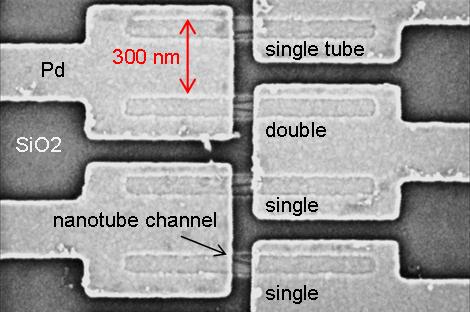
Carbon nanotubes sit on top of features etched in silicon.
IBM Research
During my visit to IBM's Watson Research Center, it was clear that people in the company is already thinking about what to do when they run into these limits. For at least some of them, the answer would involve a radical departure from traditional chipmaking approaches, swithching from traditional semiconductors to carbon nanotubes. And, while I was there, the team was preparing a paper (now released by Nature Nanotechnology) that would report some significant progress: a chip with 10,000 working transistors made from nanotubes, formed at a density that's two orders of magnitude higher than any previously reported effort.
During my visit to Watson, I spoke with George Tulevski, who is working on the nanotube project, and is one of the authors of the recent paper. Tulevski described nanotbues as a radical rethinking of how you build a chip. "Silicoon is a solid you carve down," he told Ars, "while nanoubes are something you have to build up." In other words, you can't start with a sheet of nanotubes and etch them until you're left with the wiring you want.
Read 9 remaining paragraphs | Comments
DIGITAL JUICE


No comments:
Post a Comment
Thank's!