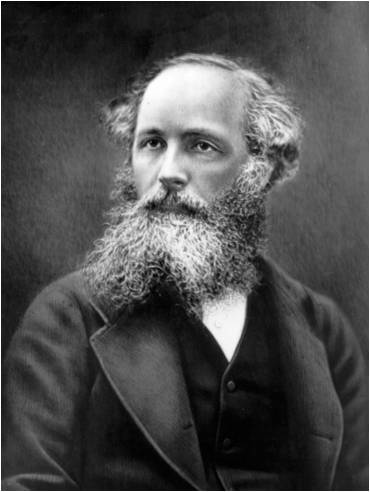
James Clerk Maxwell, who postulated a "demon" that could extract usable energy from random thermal fluctuations.
At any temperature above absolute zero, particles in a system move randomly, an effect known as thermal fluctuation. The random character of the fluctuations means they cannot be put to work in a mechanical sense (the measure of the energy unavailable for work is called entropy). 19th century physicist James Clerk Maxwell proposed a tiny intelligent "demon" that could harvest the thermal fluctuations to restore their usefulness; later work in the 20th century showed that the demon itself would have entropy, which would keep the thermodynamic books balanced.
What began as a thought experiment well over a century ago has potential interest for a variety of microscopic systems today. While the intelligent demon has fallen by the wayside, contemporary researchers are replacing it with a mindless quantum mechanical device, one that can manipulate thermal fluctuations and record its actions in some kind of memory.
Particularly, Dibyendu Mandal and Christopher Jarzynski at the University of Maryland have shown theoretically that we could make a quantum demon that would extract usable energy from thermal fluctuations, store information about its actions, and then erase the memory. This is an advance on previous Maxwell-demonic work, which never described their operations in a physical way. In principle, this demon could be used to control feedback, create nanoscale devices, and perform other functions in contexts where thermal fluctuations are significant.
Read 10 remaining paragraphs | Comments
DIGITAL JUICE
No comments:
Post a Comment
Thank's!