Here’s another one.
10F. State without proof the Integral Comparison Test for the convergence of a series
 of non-negative terms.
Determine for which positive real numbers
 the series
  converges.
In each of the following cases determine whether the series is convergent or divergent:
(i)
 ,
,(ii)
 ,
,(iii)
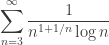 .
.I don’t know exactly what was referred to in the course as the integral comparison test, but since all the sequences being summed are monotone decreasing I’ll go for a neat statement that assumes that (and coincides with what Wikipedia refers to as the integral test).
Let
 be a decreasing real-valued function defined on the interval
  . Then the series
  converges if and only if the integral
  is finite.
Now the second part, which is pretty standard, and works very quickly if you use the integral test. I’m not sure there’s much more to say, so here’s the answer.
For every
 the function
  is decreasing. The value of
  is
is  when
when  , and
, and ![[t^{1-\alpha}/(1-\alpha)]_1^x](http://s0.wp.com/latex.php?latex=%5Bt%5E%7B1-%5Calpha%7D%2F%281-%5Calpha%29%5D_1%5Ex&bg=ffffff&fg=333333&s=0 "[t^{1-\alpha}/(1-\alpha)]_1^x") otherwise. When
otherwise. When  , this equals
  , which tends to infinity. [We could have argued instead by comparing with the case.] When
  , it equals
  , which tends to
  . Therefore, the series converges if and only if .
 We now have our first dilemma. The series we’re being asked to investigate go from 3 to
 instead of from 1 to . How much should we say about this? Should we give a more complicated statement of the integral test that allows series that start at
  ?
? Since this is a minor matter — after all, the convergence of a series is not affected by the first few terms — I suggest treating it in a minor way. That doesn’t mean ignoring it completely, but it means just indicating in a minimal way to the examiner that you are aware of the difficulty and know how to deal with it. If you do that, then the examiner cannot reasonably remove any marks. You might, for example, write this. “Since the convergence of a series is not affected by its first few terms, it is clearly enough in the examples below to find a function defined on the interval
 instead.”
Note that I haven’t even said exactly what I mean (which would have taken longer), but I’ve written something that I couldn’t have written if I didn’t know what was going on. I stress that that kind of short cut is appropriate only if what you are discussing is a side issue and not the main point of the question.
Right, let’s try to deal with these series. I myself prefer grouping terms to using the integral test — I feel that it tells me why the series converges or diverges rather than zapping it with a magic formula — but the question clearly intends me to use the integral test (even if it doesn’t actually insist on it), so I’d better do that unless it gets really horrible.
Hmm, can I integrate
 ? Yes, because it is of the form
  : I take
  and
and  . I just need something that differentiates to
  , and will do very nicely. So the function that differentiates to is
  .
. I’ll confess that I know (from the grouping terms approach) that the series
 tends to infinity like
  , and that that helped me get slightly more quickly to the observation in the previous paragraph. Anyhow, time to write something.
(i) Let
 . Then
 ![\int_3^x f(t)dt=[\log\log t]_3^x=\log\log x-\log\log 3](http://s0.wp.com/latex.php?latex=%5Cint_3%5Ex+f%28t%29dt%3D%5B%5Clog%5Clog+t%5D_3%5Ex%3D%5Clog%5Clog+x-%5Clog%5Clog+3&bg=ffffff&fg=333333&s=0 "\int_3^x f(t)dt=[\log\log t]_3^x=\log\log x-\log\log 3") .
. Since this tends to infinity, the series diverges.
What about the next part? Does anything differentiate to the function
 ? It looks horrible.
 But this is the Cambridge Tripos, and it’s a pure maths question. So it probably isn’t going to involve a horrible calculation. This is a very important clue: it means that it is a good idea to see whether we can find something that works easily.
A rather natural idea is to use the chain rule, since that worked last time. Aha! We’ve just seen that
differentiates to , so we can use the chain rule here. We just need something that differentiates to  . Well,
  does the job, so probably
  is going to do the job. Quick check: yes, that does indeed differentiate to what we want.
(ii) Let
 . Then
 ![\int_3^xf(t)dt=[-1/\log\log t]_3^x=1/\log\log 3-1/\log\log x](http://s0.wp.com/latex.php?latex=%5Cint_3%5Exf%28t%29dt%3D%5B-1%2F%5Clog%5Clog+t%5D_3%5Ex%3D1%2F%5Clog%5Clog+3-1%2F%5Clog%5Clog+x&bg=ffffff&fg=333333&s=0 "\int_3^xf(t)dt=[-1/\log\log t]_3^x=1/\log\log 3-1/\log\log x") . This converges to
. This converges to  . Therefore, the series converges.
Now for the third part. Oh dear, that’s a disgusting looking function. How on earth are we supposed to integrate that?
Here again, don’t forget that you are doing a pure maths Tripos question. It is incredibly unlikely that your examiner will expect you to do a horrible integral. (This is not just for your sake, but also your examiner’s — marking a large pile of questions that involve a lot of calculation is only marginally preferable to having your fingernails extracted one by one.) So let us use that information. It probably means that the intended method of solving this part is not integrating a function that almost certainly doesn’t have an integral in closed form.
Incidentally, some people might have been tempted to apply that argument to the function
, but I think that in the context — we were clearly going to apply the integral test at least once, managed to do so for the first part, and observed there that the derivative of is — it looked a lot less nasty than it would do if you were just presented it out of the blue.Going back to this part, if you’ve decided that actually integrating
 isn’t possible, what else are your options for solving this problem? Well, another great law of mathematics is use what you already know. This law applies with particular force in Tripos questions, where “what you already know” often translates to “what you have done earlier in the question”. Is there anything from earlier in the question that we might be able to use?
 Well, all three functions we’re supposed to look at are small modifications of
 . In the first part, the “small” modification was in fact the zero modification, and the series diverged. In the second part, we made it very slightly smaller, by dividing by
  , and it converged. So let’s try to think of how the third function relates to . And that is easy to see: it divides it by
  . So the question we’re facing is whether dividing by does enough to tip the series over from being one that diverges to being one that converges.
 Obviously if we want to decide about that, we would like some idea of what
does as  .
. A useful tip for many such questions: if you can’t immediately see the answer, take logs. You need a bit of common sense about when to apply this tip, but here, since we’re raising something to a power, taking logs has a good chance of simplifying matters.
The log of
is  . What does that do? It tends to 0. (That’s a good example of something that’s more basic than what you’re being asked to prove, and therefore legitimate to assume.) Therefore, tends to 1. But in that case it’s very unlikely that dividing by makes any difference.
 How can we prove quickly that it makes no difference? With convergence and divergence there are two principles that can be used to produce quick proofs — in conjunction with the comparison test. They are
(1) if you change finitely many terms in a series, it makes no difference to whether that series converges
and
(2) if you multiply the terms of a series by a positive constant, it makes no difference to whether that series converges.
Armed with those two principles, we have the following very short argument (which is obviously a special case of a more general fact).
(iii) Since
 as ,
as ,  . Therefore,
  for all sufficiently large
  . It follows that
  for all sufficiently large . Therefore, by part (i) and the comparison test,
  diverges.
Note that I could have argued that the function
 is bounded, and even tried to calculate a bound. But that would have involved thought and time and gained me an extra zero marks. Better to write something crude and get on to a new question.
A final remark is that if you pick out the bits of what I wrote above that were supposed to form part of the final answer, you’ll end up with something that can be written out in about three minutes (though obviously you’ll also have to spend some time thinking of the answers). That is often the case with Tripos questions: they are designed to be easy if you’re on top of the material, and quite difficult otherwise. As with the last question, I think this one was quite easy as Tripos questions go, but I can see that the
 factor might have led a number of people astray.
I’d like to end this post by explaining how I’d tackle a convergence question of another kind that sometimes comes up. What can we say about the convergence of the series
 ?
?I’m not concerned here about the answer, but about how to write a very quick and fully rigorous answer. The answer, incidentally, is obviously that it converges, since the terms decrease roughly like
 . However, the th term is bigger than , so it’s oversimplifying a bit too much to say, “By comparison with , the series converges,” even if that is more or less the right reason.
Here’s my cheating method. You just write down some very easy inequalities that hold when
is sufficiently large. For example, if  , then
  and
and  , so
, so  . Also, if , then
  is certainly at least
  , so
, so  .
. Here’s what I’d actually write for the question. It’s quick and ugly and that’s what I like about it.
If
, then and . It follows that the th term is at most  . Therefore, by the comparison test and the fact that the first nine terms do not affect convergence, the series converges.
 If your version of the comparison test is a for-
-sufficiently-large version, then you don’t even have to say, “and the fact that the first nine terms do not affect convergence.” I’m not sure what your lecturer went for. It’s tempting to waste time worrying about things like whether you could get just as good an inequality for smaller
, or whether you could improve the constant 12 when . But there’s no need. You just care about whether the series converges.If you were very short of time, you could take a gamble and just guess that the number one million is going to work, which, unless the numbers in the question are huge, it will. A safe option would be this.
If
 , then the th term is at most
  . Therefore, by the comparison test, the series converges.
A slightly riskier option is this.
For each
, the th term is at most . Therefore, by the comparison test, the series converges.In general, I don’t recommend this sort of joke approach if you’ve got a few seconds to spare, because if you make the inequality true by miles, you haven’t demonstrated to the examiner all that convincingly that you can back up the statement you are making. With the earlier version, where I said that if
then , the examiner can see where the number 10 came from (it was to make  equal to 100), so it’s clear that I haven’t just cheated and written something down that was bound to be true and not checked it.


No comments:
Post a Comment
Thank's!