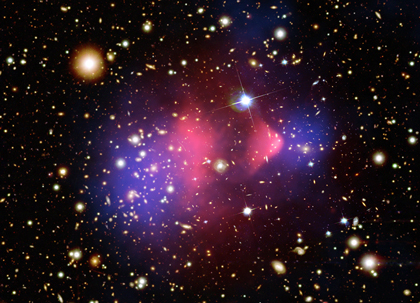
A Bullet Cluster
It is early days yet, but astrophysicists and high energy physicists are starting to get a little nervous. We know from astrophysical and cosmological observations that much of the matter in the universe is invisible to us. Indeed, the bullet cluster—a must to mention in every article written about dark matter—provides spectacular supporting evidence for dark matter. But these observations don't do a lot to pin down the properties of dark matter, other than that it is... dark: it doesn't play with electromagnetic forces (light and charge) very often.
This was all fine before the Large Hadron Collider switched on. The LHC was expected to turn up a slew of new particles—particles required to complete the standard model of physics—some of which might have the right properties to be dark matter. Unfortunately, these particles are yet to appear. They could still appear, rising out of the muddy data like a hungry crocodile. Until then, however, astrophysicists have to use the rest of the universe as their observatory to pin down dark matter. Neutron stars provide a perfect natural experiment, because, their failure to collapse into black holes tells us a lot about how fast dark matter aggregates.
Although this sounds like something very complicated, it is nothing more than measuring friction. Consider a pendulum: it swings back and forth through its rest position. As time goes on, the oscillations get smaller and smaller, until, finally, it comes to rest again. But, if there was no friction—friction in the joint of the swing, or drag from the air about the arm and mass, etc—then it would swing forever.
Read 8 remaining paragraphs | Comments
DIGITAL JUICE


No comments:
Post a Comment
Thank's!